1. Single Option
Single Option, like stocks, are financial securities that can be traded. It comes in two types, call options (call) and put options (put).
2. Long Call Option
2.1 Introduction to basic concepts
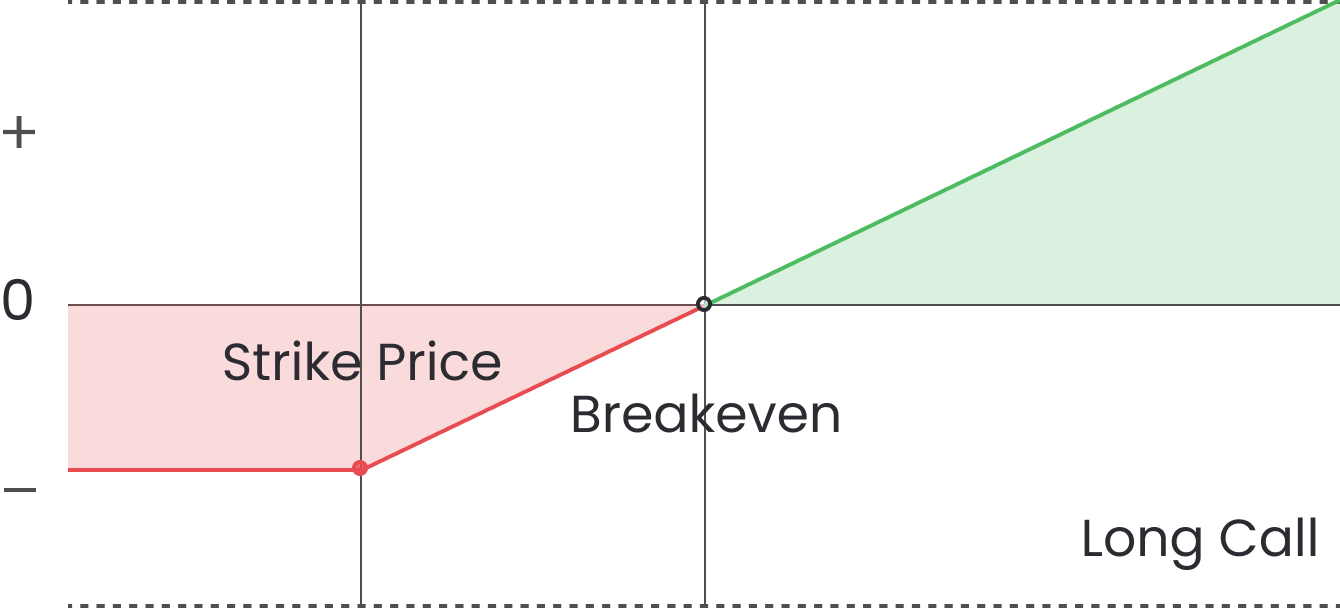
Buying a call option means you need to pay a premium to acquire a contract that grants you the right to purchase the underlying asset at a predetermined strike price within a specified period. You also have the option to not exercise this right.
In practice, the price of an option fluctuates with the price of the underlying asset. Most investors choose not to close their position through exercise but rather trade the options like stocks, buying low and selling high to capture profit.
2.2 Introduction to trading characteristics
Typically, the price of a call option moves in the same direction as the price of the underlying stock. Therefore, if you anticipate a rise in the stock price, buying a call option can be profitable.
One of the main attractions of options is their leverage effect. For call options, this means that when the stock price rises, the call option’s price typically increases more significantly; conversely, when the stock price falls, the call option’s price decreases more significantly. Thus, if you expect the stock price to rise, buying call options allows you to achieve significant gains with a relatively small investment.
The maximum loss from buying a call option is the premium paid, while the theoretical maximum profit is unlimited, as there is no upper limit to the stock price increase.
2.3 Risk and Return
Profit and Risk:
Maximum Profit: Theoretically unlimited (stock price can rise indefinitely)
Maximum Loss: The premium paid
Break-Even Point:
Calculation Formula: Strike Price + Premium
Profit/Loss Calculation at Expiry:
Calculation Formula: Stock Price - (Strike Price + Premium)
How to Profit:
Condition: If the stock price at expiry > break-even point, you realize a profit.
2.4 P/L Chart
3. Long Put Option
3.1 Introduction to basic concepts
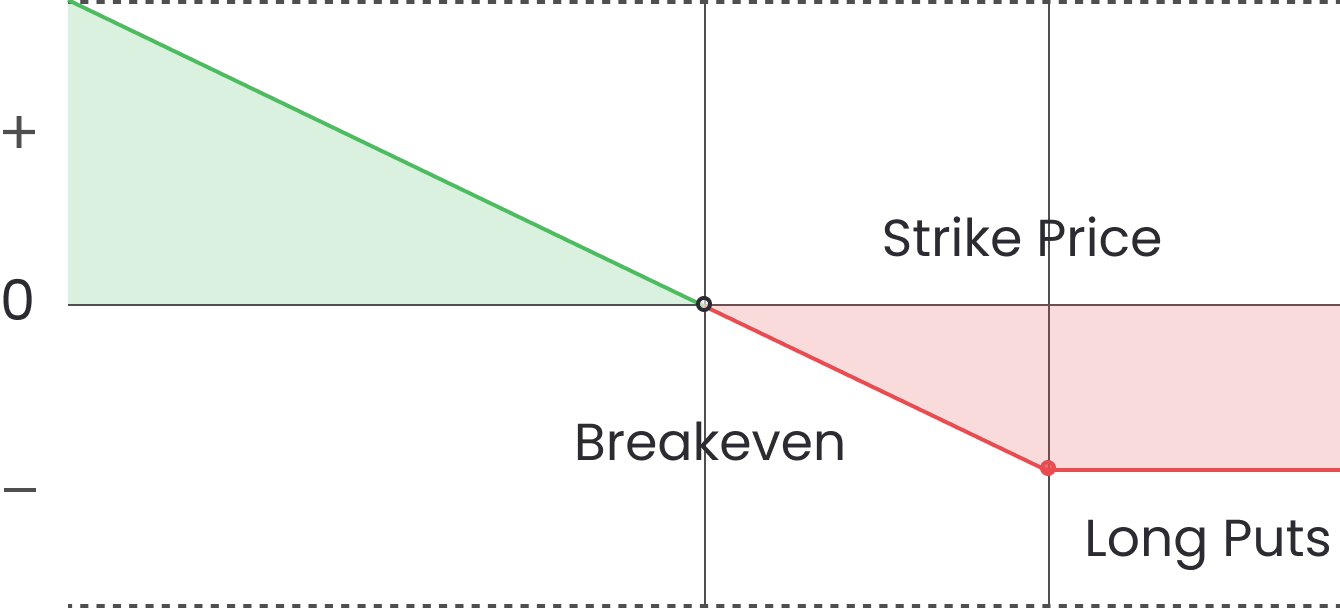
Buying a put option means you need to pay a premium to acquire a contract that grants you the right to sell the underlying asset at a predetermined strike price within a specified period. You also have the option to not exercise this right.
3.2 Introduction to trading characteristics
Typically, the price of a put option moves in the opposite direction of the price of the underlying stock. Therefore, if you anticipate a fall in the stock price, buying a put option can be profitable.
One of the main attractions of options is their leverage effect. For put options, this means that when the stock price falls, the put option’s price typically increases more significantly; conversely, when the stock price rises, the put option’s price decreases more significantly. Thus, if you expect the stock price to fall, buying put options allows you to achieve significant gains with a relatively small investment.
The maximum loss from buying a put option is the premium paid. Theoretically, the maximum profit occurs when the underlying stock price falls to zero, resulting in a profit equal to the strike price multiplied by the number of shares minus the cost of purchasing the put option.
3.3 Risk and Return
Profit and Risk:
Maximum Profit: Relatively large (if the stock price falls to zero)
Maximum Loss: The premium paid
Break-Even Point:
Calculation Formula: Strike Price - Premium
Profit/Loss Calculation at Expiry:
Calculation Formula: Strike Price - Premium - Stock Price
How to Profit:
Condition: If the stock price at expiry < break-even point, you realize a profit.
3.4 P/L Chart