1. Usage scenarios
You can use a reserve call option strategy when you think the price of the stock you hold will rise slightly or fluctuate moderately for some time to come.
2. How to build
The reserve call option strategy consists of two parts of trading:
● Long stocks
● Short calls
The number of stocks purchased is equal to the number of stocks corresponding to the call.
3. Strategy brief
A reserve call option strategy consists of stock and option trading. Judging from the name, a short-term call refers to buying stocks to cover the risk exposure of selling calls.
However, in the actual application of this strategy, buying stocks is the main trading part, and selling calls is the auxiliary trading part.
In trading, compared to only buying underlying stocks, investors choose to hold shares and sell for two purposes:
● "holding shares and collecting rent" to increase additional income.
If you are optimistic about a stock and hold on to a certain stock for a long time, you can obtain additional income through calls to sell that stock on a rolling basis, which has the effect of reducing the cost of holding a position.
Since the passage of time favors option sellers, preparing for call options is equivalent to "holding shares and collecting rent". If you want to get "rent", you can choose to sell recent months of deep fictitious calls.
The recent month was chosen because its time value was lost more quickly, and the deep fictitious value was chosen because it is not easy to exercise power in this way, and the purpose of holding stocks for a long time can be achieved.
If you have confidence in your ability to predict and think that the stock price will trade sideways or fall slightly in the short term, you can also choose to sell calls that have been slightly false or flat in recent months.
Generally, you get more options from selling calls with mild fictitious or equal value in recent months compared to recent months of deep fictitious value.
● lock in stock selling prices in advance.
After an investor buys a stock, if they have a clear target price to sell the stock, they can choose this price as the exercise price to sell the call.
If the stock price reaches the target selling price, not only can you sell smoothly, but you can also get an additional option premium for selling calls.
If the target price is not reached, you can still get premium to sell the call option and continue the "share ownership and rent" model.
Finally, it is important to note that if you choose to use a reserve call option strategy, if there is a sharp rise and fall in stock prices in the future, it will be detrimental to overall earnings.
If the stock price rises sharply, selling calls will limit the overall profit margin. When the stock price reaches the sum of the exercise price and premium and continues to rise, then the profit from these rising portions has nothing to do with you. At that time, the profit from preparing for call options will not be as good as holding the stock alone.
If the stock price falls sharply, holding the portion of the underlying stock will cause a loss in overall earnings. Since selling calls will generate additional revenue, a reserve call option strategy is still superior to holding stocks alone and will reduce some losses.
4. Risk and Return
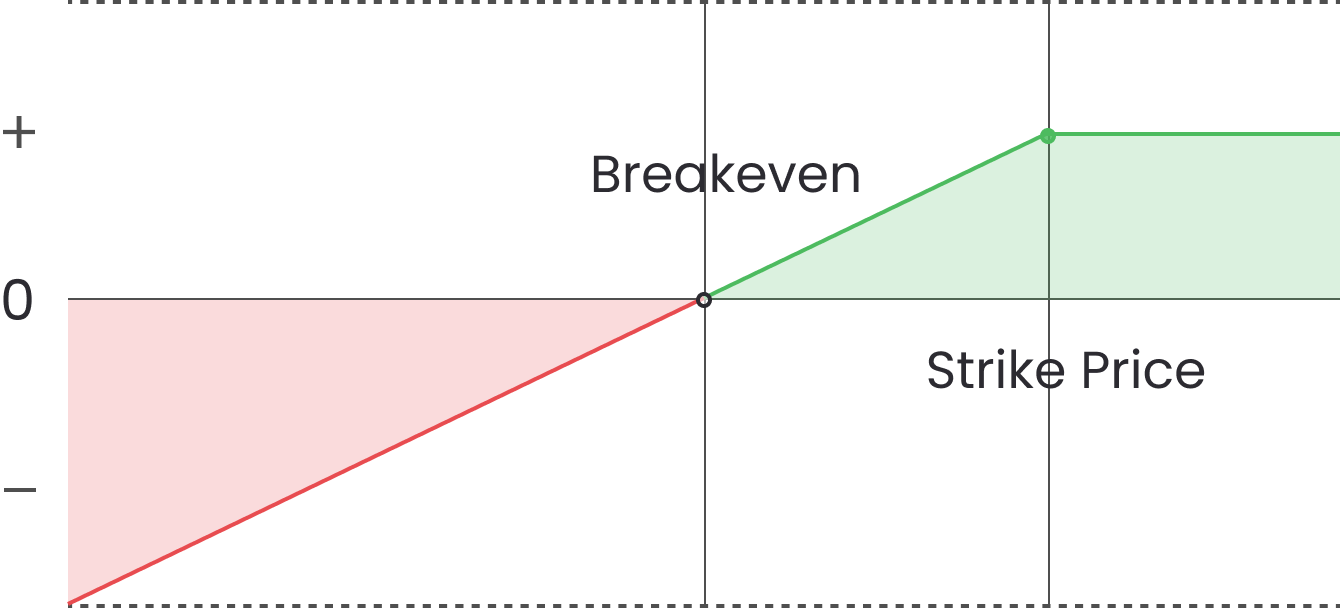
P/L:
Max Profit: Strike Price - Stock Cost + Purchase Cost
Max Loss: Stock P/L + Purchase Cost
Breakeven: Stock Cost - Purchase Cost
P/L Calculation Formula:
Stock Price >= Purchase Cost: Strike Price - Stock Cost + Purchase Cost
Stock Price < Purchase Cost: Stock P/L + Purchase Cost
How To Make Profit?
Stock Price > Breakeven Price
5. P/L Chart