1. Usage scenarios
If you anticipate that the stock price will fluctuate significantly in the future, but are unsure whether it will rise or fall, you can use the long cross-portfolio strategy.
2. How to build
Long a cross-portfolio consists of two options trades:
● Long call
● Long put
The underlying stock, exercise price, quantity, and expiration date of call and put are all the same.
3. Strategy brief
Long a cross-style combination consists of buying calls and puts with the same target, exercise price, quantity, and expiration date (generally choosing equal options). Buying calls and puts at the beginning of establishing this strategy requires spending option premiums.
If the stock price subsequently rises, the profit is obtained by buying the call portion; if the stock price falls later, the profit is obtained by buying the input portion.
Regardless of whether it rises or falls, as long as the increase or decline is large enough so that the profit obtained by buying a call or put is greater than the option premium spent, a profit can be made.
This structure makes buying cross-style combinations have the following characteristics:
● The strategy's losses are limited, and the potential profit is limitless. The biggest loss of this strategy is the cost of buying options. The unlimited potential profit is due to the possibility of unlimited profit from buying the call portion.
● The strategy does not depend on the direction of future changes in the stock market price.
Buying calls is bullish and buying put is bearish. When combined, it is possible to hedge against directionality. At the same time, buying calls and puts with the same elements is theoretically possible to achieve complete hedging in direction.
Professionally speaking, this is called the delta neutral strategy. The purpose of constructing this strategy is not to be affected by changes in stock prices. Buying cross combinations is one of the most common delta neutral strategies.
● Time decay is bad for strategy. Time decay is not good for option buyers, and is one of the characteristics of options. Investors who buy cross-style portfolios are pure option buyers, and time decay is naturally detrimental to strategy.
● Buying cross-portfolio portfolios is a strategy to increase volatility. Investors using this strategy can not predict whether stocks will rise or fall, but it must be based on the expectation that "stocks will fluctuate clearly in the future", that is, they are optimistic about future market volatility changes.
Judging from the impact of volatility on option prices alone, if the volatility in the future market rises and the price of options rises, it is suitable for buying options. Conversely, future market volatility decreases, making it suitable for selling options.
This is also the main difference between buying a cross portfolio and selling a cross portfolio — buying a cross portfolio is a strategy for going long on the volatility, and selling a cross portfolio is a strategy for shorting the volatility.
4. Risk and Return
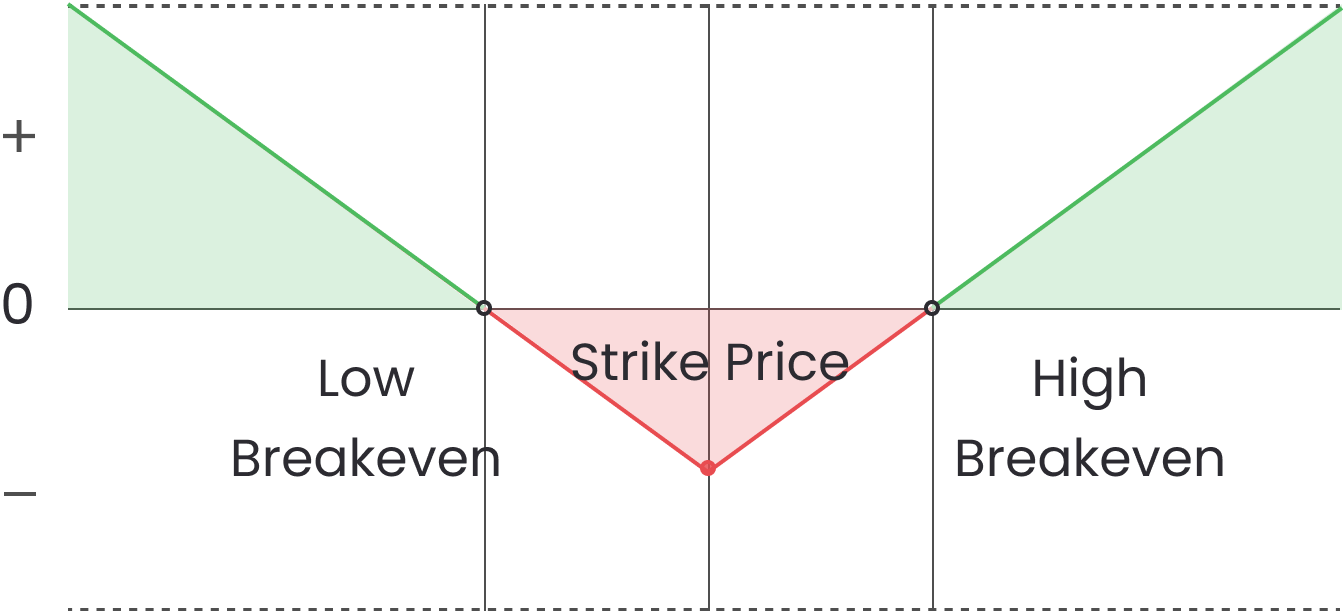
P/L:
Max Profit: Unlimited
Max Loss: Purchase Cost
Breakeven:
High Breakeven: Strike Price + Purchase Cost
Low Breakeven: Strike Price - Purchase Cost
P/L Calculation Formula:
Stock Price >= Strike Price: Stock Price - Strike Price - Purchase Cost
Stock Price < Strike Price: Strike Price - Stock Price - Purchase Cost
How To Make Profit?
Stock Price < Low Breakeven Price
Stock Price > High Breakeven Price
5. P/L Chart